

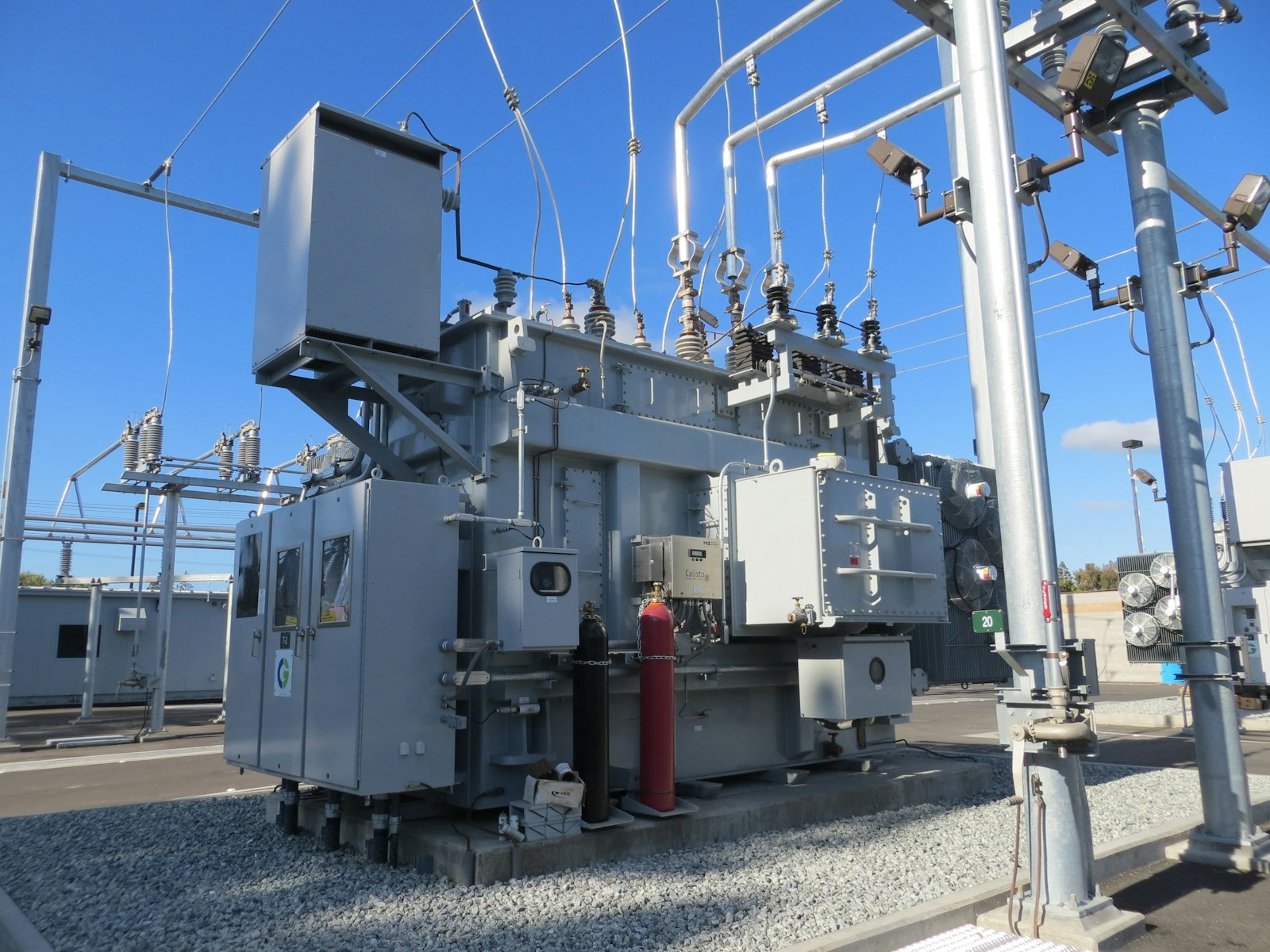
 Photo: American Public Power Association / Unsplash
Partial discharge is the quiet beginning of most insulation failures in switchgear, transformers, cables and motors. It is also, quite literally, audible: each discharge emits an acoustic pulse. Our 2021 research applied deep neural networks to airborne acoustic emission to detect and classify partial discharge automatically. Here is why that matters for anyone responsible for electrical assets, from a utility substation to a steel plant's power distribution.
Why partial discharge is worth listening for
Insulation rarely fails suddenly. It degrades, and partial discharges appear months before breakdown, growing in frequency and energy. Detecting them early turns an unplanned outage into a scheduled repair. Conventional methods, electrical measurement with coupling capacitors or periodic manual ultrasound surveys, are either expensive to install permanently or only give you a snapshot on the day the technician walks by.
The approach
We recorded airborne acoustic emission from equipment with and without partial discharge activity, compared several time-frequency representations of the signal, and trained deep neural networks to detect and classify discharge events. Two aspects were important beyond the model itself.
- Representation matters. Different time-frequency transforms exposed the discharge pulses differently; choosing the representation was as important as choosing the network.
- Evaluation was designed around maintenance decisions. The question was not "what is the accuracy?" but "at what false-alarm rate can this run continuously without a maintenance team ignoring it?"
The result was automatic, non-contact detection suited to continuous monitoring, published in 2021. As with all our work, the specific figures are in the paper, which we share on request.
From research to a monitored substation
In a deployment, ultrasonic-capable microphones are placed at panels or bays, an edge device runs the detector continuously, and only events, with their acoustic fingerprint and severity trend, are forwarded to the maintenance system. No electrical connection to the asset, no outage for installation, and no raw data leaving the site. For multi-site utilities, federated learning lets detectors improve across substations without centralising recordings.
For Indian industry this is relevant beyond utilities. Steel, cement, chemicals and large automotive plants operate their own high-voltage distribution, and an unplanned transformer failure stops the whole site. Continuous acoustic partial discharge monitoring is one of the highest-value, lowest-intrusion applications of sensing AI we know.
Key takeaways
- Partial discharge precedes most insulation failures and is acoustically detectable months in advance.
- Deep networks on airborne acoustic emission detected and classified discharges without contact.
- The time-frequency representation matters as much as the model.
- Evaluate at the false-alarm rate a maintenance team can live with.
- Edge deployment enables continuous, sovereign monitoring of substations and plant power distribution.
If any of this matches a problem on your line, the fastest way to find out what is possible is a free discovery call followed, where it makes sense, by a feasibility study of two to ten days.